What Lives on Your Counters Says More Than You Think
There’s something quietly revealing about a counter.
It isn’t meant to be storage. It isn’t exactly display. It’s not a shelf and it’s not a drawer. A counter is a working surface, but over time it becomes something else. It becomes neutral territory. A place where life pauses for a moment before it gets sorted.
And because of that, counters end up holding far more than they were ever designed to.
If you walk into almost any home and really look at the kitchen counters, the entry console, the bathroom vanity, or the bedroom dresser, you can start to see patterns. Not just about tidiness, but about pace. About stress. About unfinished tasks. About how a household moves through a day.
Counters tell the truth about where friction exists.
Not in a dramatic way. Not in a way that requires a full declutter weekend. But in small, quiet ways that add up over time.
Counters Are Where Decisions Get Deferred
One of the most common things you’ll see on a counter is paper.
Mail stacked in a small pile. School forms waiting for signatures. A bill that needs to be paid. A return label that hasn’t been taped to the box yet.
Paper rarely stays out because it belongs there. It stays out because it represents something unfinished. And unfinished tasks create a subtle background hum in your mind. Even if you’re not actively thinking about them, you know they’re there.
That low-grade awareness builds over time.
The same is true for small objects that collect near the edge of a counter. Batteries. Scissors. A random screwdriver. Hair ties. Loose change. A tape dispenser. They drift there because they’re needed occasionally, but they don’t have a simple, obvious home.
When storage feels inconvenient, counters absorb the overflow.
It’s not a lack of discipline. It’s usually a lack of friction-free placement. If putting something away requires walking to another room, opening a container, moving something else, and closing it again, it won’t happen consistently. So the counter becomes a temporary holding space that slowly turns permanent.
Visual Density Affects How a Room Feels
Most people assume a space feels stressful because it’s dirty. In reality, visual density often plays a larger role than actual cleanliness.
You can wipe down every surface in a kitchen and still have it feel heavy. You can mop the floors, scrub the sink, and polish the appliances, but if the counters are crowded with ten small items instead of three intentional ones, your eyes don’t get a place to rest.
Our brains are constantly scanning our environment for information. Every object sends a signal. When there are too many signals competing at once, the room feels noisy, even if it’s quiet.
This isn’t about minimalism. It’s about breathing room.
A counter doesn’t need to be empty to feel calm. It needs space between objects. It needs intention. It needs to look like what’s there was chosen, not just left.
When counters feel crowded, the entire room feels unfinished.
Appliances and the “Just in Case” Habit
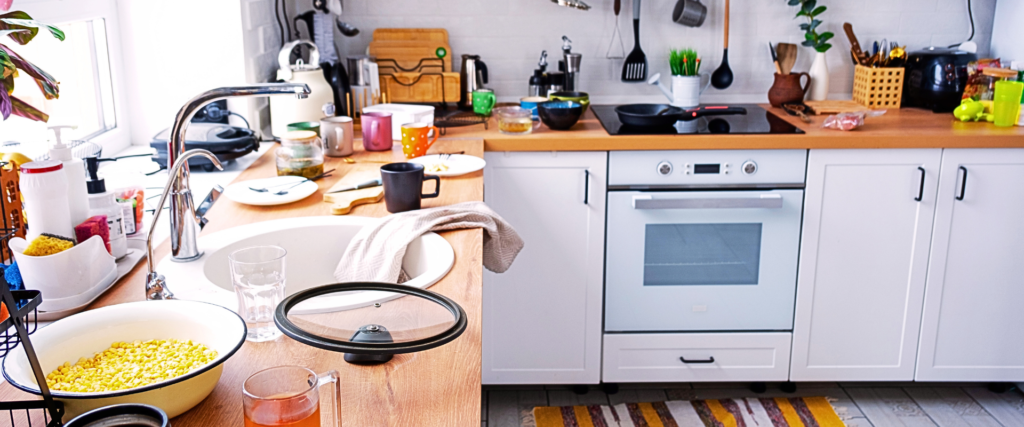
Kitchen counters are especially vulnerable to this. Appliances slowly take up permanent residence. The toaster. The blender. The stand mixer. The air fryer. The coffee grinder. The cutting board that never gets put away.
Individually, none of these items are excessive. Together, they start to consume the surface.
Often the reasoning is practical. You use them. You might use them. You don’t want to lift something heavy out of a cabinet. You don’t want to move things around to store it.
But when everything stays out, the counter becomes storage instead of workspace.
And when your primary workspace feels visually full before you even begin cooking, the simple act of making dinner can feel like more effort than it should.
Sometimes the shift isn’t about getting rid of appliances. It’s about asking which ones truly deserve daily visibility. A coffee setup might make sense. A toaster might make sense. But does the stand mixer need to live there year-round? Does the specialty appliance you use twice a month need to be part of the visual landscape every day?
Editing a counter doesn’t require eliminating everything. It requires choosing.
Entry Counters and the Emotional First Impression
Counters aren’t just in kitchens.
The entry table or console often carries its own story. It’s where keys land. Where mail gets dropped. Where packages sit until someone opens them. Where sunglasses, receipts, and random small items gather.
This is the first surface you see when you walk in the door.
If it’s scattered and layered with unfinished things, your body registers that immediately. You may not consciously say, “This space is chaotic,” but your nervous system notices.
On the other hand, if the entry surface is contained — a small tray for keys, one basket for mail, maybe a lamp — it communicates order before you even step further inside.
The first surface sets the tone for the entire house.
Bathroom Counters and Decision Fatigue
Bathroom counters reveal something slightly different.
Multiple skincare bottles. Half-used products. Hair tools left plugged in. Makeup scattered in small containers. Toothpaste, floss, mouthwash, lotions.
When everything lives out in the open, even if it’s technically organized, the number of choices can feel overwhelming.
You don’t need ten products in sight to get ready. But if they’re all there, your eyes process them anyway.
Clearing even a portion of a bathroom counter can feel unexpectedly relieving. Not because it’s aesthetically pleasing, but because it reduces micro-decisions.
The fewer things competing for attention, the smoother a routine becomes.
Bedroom Surfaces and Unfinished Cycles
Dressers and nightstands tell a slightly different story.
Clothes that were tried on but not put away. Jewelry removed at the end of the day. Water glasses. Books. Receipts pulled from a purse. A stack of mail that never made it to the kitchen.
Bedroom counters and surfaces often hold the residue of exhaustion.
They show where the day ended abruptly.
Clearing one surface in a bedroom — even just a nightstand — can change how the entire room feels in the morning. Waking up to a clear surface communicates readiness. It suggests the day isn’t already behind you.
The Goal Is Not Empty. It’s Intentional.
It’s important to separate the idea of calm from the idea of minimal.
A home doesn’t need to look staged to feel good. You don’t need bare counters and perfectly styled trays.
What matters is whether what lives there feels chosen.
If you use it every day, it probably deserves to stay. If it lands there because there isn’t an easier place, that’s worth noticing. If it’s been sitting there for weeks without purpose, that’s information.
A functional counter might hold a coffee maker, a small bowl of fruit, and a paper towel holder. That’s normal. It’s the additional five small items that accumulate around them that start to change the tone.
The difference between busy and overloaded is often just a few objects.
A Small Experiment
You don’t need a dramatic reset to see the impact.
Clear one counter completely. Just one.
Remove everything. Wipe it down. Then place back only what you use every single day. Stand there and look at it for a moment.
Notice how it feels.
You may find that you don’t miss most of what was there. You may realize that a large portion of what occupied the space was simply waiting for a decision.
And decisions are heavier than objects.
What Surfaces Reflect About Pace
Counters reflect how fast a household is moving.
In seasons of busyness, surfaces fill more quickly. Things land and stay because there isn’t time to sort them. In calmer seasons, surfaces stay clearer because there’s margin to reset them.
Instead of viewing a full counter as failure, it can be more useful to view it as feedback. It might be telling you that the pace is high. That you need easier systems. That certain tasks are stacking up.
The surface itself isn’t the problem. It’s the indicator.
A Home That Works Begins With Friction
If your goal is a home that works for real life, surfaces are one of the simplest places to start.
When you don’t have to move six objects to start chopping vegetables, dinner feels easier. When you don’t have to dig through paper to find your keys, leaving the house feels smoother. When you don’t wake up to stacks of unfinished items, the day feels less heavy.
Counters are small spaces. But they are high-impact spaces.
What lives on them quietly shapes how your home feels, how your routines flow, and how your mind settles at the end of the day.
You don’t need a renovation to change that.
Sometimes you just need a surface.
If you’re ready to take it one step further without overhauling your whole house, these two are a good place to start:
➡️ A Nightly Kitchen Reset That Makes Tomorrow Easier
https://www.featuredbite.com/nightly-kitchen-reset/
➡️ Kitchen Cleaning Hacks That Actually Work
https://www.featuredbite.com/kitchen-cleaning-hacks-that-actually-work/
Both focus on reducing friction in the spaces that tend to create the most daily stress.